Friday, October 11, 2013

10.14.13 - VSEPR, Lab Data, Formal Charges, and Resonance Structures.

VSEPR Theory Lab

This week, we started off by finishing the VSEPR theory lab. In the worksheet, VSEPR Theory Lab (1), we went through 13 examples of molecules and found it's Electron Domain Geometry and Molecular Domain Geometry.

In order to determine the Electron Domain Geometry, you must...
1. Draw a Lewis Structure for the molecule.
2. Count the number of bonded atoms around the central atom.
3. Count the number of lone pair electrons around the central atom.
4. Figure out its molecular class.
5. Find out its Geometric shape.

  • Total of two bonded atoms and lone pair electrons: linear.
  • Total of three bonded atoms and lone pair electrons: Trigonal Planar.
  • Total of four bonded atoms and lone pair electrons: Tetrahedral.
  • Total of five bonded atoms and lone pair electrons: Trigonal Bipyramidal.
  • Total of six bonded atoms and lone pair electrons: Octahedral.
In order to determine the Molecular Domain Geometry, you must...
1. Find the Electron Domain Geometry.
2. Think of what the shape that the Bonded atoms would take (the red balloons, in context of our lab)
  • They would be either linear, bent, trigonal planar, tetrahedral, trigonal pyramidal, trigonal bipyramidal, seesaw, T-shape, octahedral, or square pyramidal.
To follow this main idea, we did a lab using balloons and gum drops. Balloons helped us figure out the Electron Domain Geometry by tying the red balloons (bonded electrons) and the white balloons (lone pair electrons) together. The gum drops represent the Molecular Domain geometry (Orange was the central atom, black was the bonded atoms). The gum drops were tied with toothpicks that depicted the shape of the molecules relatively accurately.

Lab Data

We also finished figuring out the answer to our lab questions from last week (What is the mass percent of copper in a brass sample?). This is our class data:
By using the information given, we figured out the mass percent of copper.

After doing some stoichiometry, we found that the mass percent of copper was 58.7%
Later next week, Dr.J will (try to) give us our lab reports from the last lab back in order to finish our lab this week of brass.

Formal Charges

We had a lecture quiz on formal charges, as well as a Pogil (Lewis Structures (III)) to further become comfortable with the material. To calculate formal charge, you must...
1. Make a Lewis structure for the molecule.
2. Count the number of electrons corresponding to the atom you are trying to figure out.
3. Subtract the number of original electrons (from the periodic table) by the number of assigned electrons.
Here's an example.

Resonance Structures

We also did a Pogil for Resonance Structures (Lewis Structures (III)) to understand which formal charge is the best for each molecule. By figuring out the resonance structures of the molecules, we were able to decide which structure was the best for that molecule (the one with the least number of formal charges).

Main Ideas

I understood most of the material that we learned this week, such as formal charges, resonance structures, bond order, and hypervalancy, however I still have trouble finding the Electron Domain Geometry and Molecular Domain Geometry for molecules. Why can't H2O be linear, instead of bent? Does the structure look like this?
All of the material we learned this week helps us understand the deeper facts of Lewis structures, beyond their models. VSEPR theory is a really interesting idea to me, however I wish I could become more comfortable with it. Next week, I will probably have more questions about the lab as well.

Friday, October 4, 2013

10.7.13 - Bond Order and Bond Strength, Brass Lab, and VSEPR Theory Lab

Bond Order and Bond Strength

First, before the worksheet, we went through some Lecture Quizzes that gave us an understanding of how to draw Lewis Structure Diagrams. Here are the steps:

1. Calculate the total number of valance electrons for the molecule.
2. Draw the skeleton structure for the molecule. The least electronegative element should be the central atom.
3. Make bonds between the surrounding atoms and the central atom.
4. Distribute as many remaining valence electrons to the surrounding atoms until their octet (or duet) are filled.
5. Distribute the rest to the central atom. If there is not enough, borrow lone pairs of electrons from one or more surrounding atoms and create multiple bonds until the Octet Rule is satisfied.

This week, we started off with a Pogil on Bond Order and Bond Strength. Bond Order is the number or pairs of electrons that are shared between two elements. Bond Energy (kJ/mole) is the energy required to sever the bond that holds two adjacent atoms together in a molecule. We found that the bigger the bond order, the bigger the bond energy. Bond length is the distance between the nuclei of two bonding atoms. As bond length increases, bond energy decreases.
We went through lots of practice to become comfortable with this material. I feel that I understood this pretty well, because it is basically a little bit more detail added to the Lewis Structure Diagram.

Brass Lab

Before we started our lab, we received a sheet of productive and non-productive beginning questions.

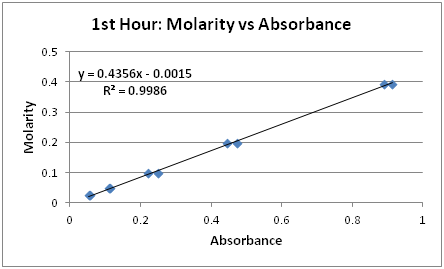
This week, we started on our Brass lab. The main goal of this lab is to find the percentage by mass (mass percent) of copper in brass screws. As a class, we decided to investigate these question: what is the relationship between the absorbance of the solution and the concentration of copper, and how does deducting concentration visually compare to the measurements of the colorimeter?

The procedure includes reacting the brass solution in HNO3 to produce a light blue solution of Copper.
Then, we took the stock solution of 0.393M and made a serial dilution of 0.200M, 0.100M, 0.050M, and 0.025M. We then measured the absorbance using the colorimeter.

Next week, we will interpret the class data and write our lab report.

VSEPR Theory Lab

We were introduced to the VSEPR Theory on Friday. VSEPR Theory predicts the shape an individual molecule will take depending on their bonding and non-bonding electron pairs.

Electron domains are the number of bonds there are between the elements. For example, carbon dioxide has an electron domain of two, because there is one bond between O and C, and another between C and O.

The shapes of the pairs are not perfect circles or lines. To show this, we tied small red balloons to represent the bonded pairs and larger white balloons to represent the non-bonding pairs. For example, ClF3 would look like this:

To go along with the new material, we did VSEPR Theory Lab (I), as well as the balloon models.

Main Ideas

This week, I feel like we went deeper into the bonds that tie together the elements and the structure of the molecules. However, I still have trouble understanding the shape of the compounds according the the VSEPR theory. The balloon structures representing the region in which the electrons are most likely found make sense to me, but I don't understand how the actual molecules look like. I think I will come to an understanding once we go over this worksheet and see the other models of other molecules. Other than that, I feel I understand the material we went over this week. I think there will be more problems when we enter the next week, where we discuss the results of the Brass Lab and finish up the VSEPR theory lab. Because I was not in class on Tuesday, I don't think I've participated very well this week. My ideas about the structure of a molecule has definitely changed after the VSEPR theory lab. I also feel really excited about doing more labs in this class now that we did a lab with real chemicals and fairly strict safety precautions. I just need to remember to use more drawings in the lab procedures.

Friday, September 27, 2013

9.30.13 - Stoichiometry exam and introduction to the Lewis Structure

Stoichiometry exam

In the exam, we covered all of the stoichiometry we've gone over this year so far. This includes converting moles to grams, finding mass given the mass of the reactants, balancing chemical equations, reaction particle diagrams, empirical formulas, and many other application of stoichiometry and the concept of Moles.

My overall score was an 83.3%. I scored 86.7% on the multiple choice, and 80% on the free response. Most of the questions I missed were not because of the lack of comprehension, however I feel I could have done better if I was more comfortable using the stoichiometry and molar mass tools that we learned in class or over the lectures. The hot potato quizzes helped with the test because they gave very similar questions.

Lewis Structures

Starting last Thursday, we were introduced to the Lewis Structure Diagram. This diagram is based on the atoms' outer valance electrons and their ability to bond with other atoms. The core charges of the atoms are equal to the number of dots in the diagrams. Shared electrons in a covalent bond are expressed with a line between the letters.

Some of the rules for Lewis Structures include:
1. The atom has to have the correct letter to represent the element and the correct number of valance electrons.
2. The sum of the shared electrons and the lone pair electrons must be eight--an octet. 
3. Hydrogen is a duet.


The total number of valance electrons in a compound are the valance electrons of the individual elements added up.

F2=14 valance electrons 
SiH4= 8 valance electrons 
PCl3= 26 valance electrons
O2-2= 12 valance electrons

We did a Pogil ("Lewis Structure(1)")on this to make sure we understood the material. We also did some whiteboarding to compare our answers with other groups.

Main Ideas

Stoichiometry and the Lewis Structure do not connect in my head yet, because the Lewis Structure is still a new topic to us. However, the main idea of this week was to see if we understood stoichiometry (by taking the test) and becoming familiar with the Lewis Structure. I am relatively comfortable with the new material, so I do not have any questions. I feel that I participated a lot this week in our activities because (I think) I lead a lot of the discussions on the questions in the pogil in our group. My ideas changed about the Lewis Structure because I'm a little more comfortable with it, compared to last year. 

Friday, September 20, 2013

9.23.13 - Reaction Particle Diagram, Stoichiometry (limiting reactants and yield), and Empirical Formulas

Reaction Particle Diagram

The main idea of the Reaction Particle Diagram was to learn the standard way of drawing particle diagrams. When given a reaction, you must...
1. Balance the equation
2. Draw the correct amount of molecules before the reaction (all spread out)
3. Draw the correct number of molecules after the reaction (including the excess molecules)

In class, we white-boarded the packet "Reaction Particle Diagrams" to go along with this idea. This helped us because it gave us a lot of examples and lots of practice to get us comfortable with drawing these diagrams.

Stoichiometry - limiting reactants

The main idea of limiting reactants in stoichiometry was to understand how to calculate mass of a reaction with limited amounts of reactants. To find the mass, set up two (or more) ratios of the given masses of the two (or more) elements to find which one produces the least amount of a substance. Then, once you find the least amount of product that can be made, go backwards to find the amount of other molecules used to make that product.

In class, we worked on a few worksheets (Stoichiometry(6), (7)). The worksheets allowed us to get some more practice with the new idea.

Stoichiometry - yield

The main idea of yield is that never in reaction is there going to 100% of all products as the result of a chemical reaction. There will be some left inside the container, making the amount of solution less than what is theoretically predicted.

We also got a worksheet in class (Stoichiometry 8 - Yield) to get use to doing these types of problems.

Empirical Formulas

Empirical Formulas describes the relative number of each type of atom in a compound. It is given as the smallest whole number ratios. For example, although glucose is C6H12O6, its Empirical Formula is CH2O. To find the empirical formula given the percent composition...
1. Assume there are 100g of the product in total. All percents given become grams.
2. Find how many moles of each molecule there are in the product.
3. Divide each number of moles by the smallest number of moles.
4. Make sure they are all whole number ratios.

We worked on a worksheet to become comfortable with the new material. There were lots of practice to do this.

In addition to this, we were introduced to Empirical Units and Molecular Formulas, and Mass Percent. Empirical Units and Molecular Formulas basically take the Empirical formula and multiplies it by the number of atoms in the compound, given the molecular molar mass of the compound. 


Mass Percent is the percent of a specific element or molecule in a compound.

Main Ideas

All the ideas we learned this week connect because we need to know one concept in order to understand the next one. We are not able to find Empirical formulas without knowing the basics of Stoichiometry. This is the same for reaction particle diagrams, limiting reactants, yield, Empirical Units, molecular formulas, and mass percent. I understand the concepts of reaction particle diagrams, limiting reactants, yield, and empirical units/molecular formulas, but I think I need more practice on mass percent. I don't understand the question when it asks "Find the mass percent of the compound in the sample". If the compound is the sample, wouldn't it just be 100%? I understand the steps you take to find the answer, but I don't understand what the number in the answer represents. I feel that I participated well in the learning process because I helped out with white-boarding the answers to the worksheets. I'm fairly confident in the subject we learned this week. I just need to work on mass percent, and maybe a series of random practice problems to know when to use what method of ratios. Because these ideas are a lot like the concepts we learned last week, I have no change in my ideas. However, I'm wondering what kind of questions will be on the actual AP exam? Will these Stoichiometry problems be on there?

Saturday, September 14, 2013

9.16.13 - Stoichiometry and Blue #1 Dye Lab Report

Stoichiometry

The main idea of stoichiometry this week was to understand how to use conversions to figure out a problem containing different units. We have done two worksheets on stoichiometry to further understand and master the concept. For example,

How many grams of gold would be produced from 551g of gold (III) oxide in the reaction 2Au2O3 --> 4Au + 3O2? (molar mass of gold (III) oxide is 441.93 g/mol)


The main idea is to multiply the given value by different forms of 1 in order to get the same results in a different unit. For example, in the equation above, the numerator and the denominator all equal each other (1 mol Au2O3 = 441.93g Au2O3). That way, we can change the units of the given number without changing the actual value (anything multiplied by one will equal itself).

Lab Report - Blue #1 Dye

This week, we performed a lab with Blue #1 Dye and different kinds of sports drinks. The question to guide our lab was "What is the Relationship Between the Concentration of a Solution and the Amount of Transmitted Light Through the Solution?" and "How many grams of Blue #1 Dye is there in 500mL of Powerade and Gatorade?". 

As we collected data, we found that the absorbance and concentration of Blue #1 Dye had a direct linear relationship. This was related by the equation y=0.1385x-0.0078 (x=absorbance and y=concentration).

The activity that really tied everything that we learned this week was to find the mass (g) of 500mL of Powerade and Gatorade. We applied our knowledge of stoichiometry to our lab to see how much dye was in our drinks (the equation and process are all in the lab notebook). We found out that there is approximately 1.98x10⁻⁴g of Blue 1 Dye in Powerade, while in Gatorade, there were 5.15x10⁻⁵ g.

In addition to the lab, we worked on post lab questions. These questions tested us if we knew our material well. The first question asks us how to find concentration given the concentration and volume of the diluted solution. Here, we used the equation M1V1=M2V2to find the concentration in uM.
Here is the work:


The concentration of the original stock turns out to be 17.5uM.

Main Ideas

The main ideas this week were to become comfortable with stoichiometry, how labs work in the class, how to use our lab notebooks, and how stoichiometry can be applied in labs.

I'm still uncomfortable using stoichiometry to convert units. I wasn't sure where to start when we white-boarded our problems for the mass of Blue #1 dye. I feel that I participated well by knowing how to use the colorimeters properly and doing the prelab activities before the lab, however I don't think I understood stoichiometry as well as I should have. My ideas have changed about converting units. I had thought they were very easy to do, however after learning stoichiometry, I understood that there were more steps in the conversion than what I had imagined.